Calm in Motion: 3-Step Micro-Practice to Beat Stress

Calm in Motion: A Daily Practice for Steadier Focus and Less Stress
Stress rarely shows up as one big event—it accumulates through notifications, deadlines, and constant mental switching. Calm in Motion is a simple, repeatable way to lower stress throughout the day using mindfulness micro-practices paired with AI-guided reflection, so inner balance and focus become part of normal routines rather than another task to “keep up with.”
Why stress sticks in everyday life
Stress builds when the nervous system stays in “on” mode. Frequent interruptions, unresolved to-dos, and low recovery time keep the body primed for threat—even when the day is objectively “fine.” Over time, this can shift stress from an occasional spike to a constant background hum.
Common triggers include time pressure, social friction, decision fatigue, digital overload, and poor sleep rhythms. The tricky part is that stress often hides in plain sight: irritability, forgetfulness, tight shoulders or jaw, restless scrolling, or leaning on caffeine and sugar just to push through.
The goal isn’t removing all stress. It’s shortening recovery time and reducing how often stress runs the day. For a helpful overview of how stress affects the body, see the American Psychological Association’s stress resource.
Calm in Motion: the 3-part loop (Notice → Reset → Choose)
This practice works because it’s small enough to repeat—many times—without needing a perfect environment or a long session.
1) Notice
Name what’s happening without judgment: body sensations (tight chest, buzzing energy), thoughts (catastrophizing, “I’m behind”), and urgency (“I have to fix this now”). Labeling creates a little distance and often reduces emotional intensity.
2) Reset
Use a 30–90 second regulation tool—breath, grounding, movement, or sensory focus—to shift physiology. A reset is not “positive thinking.” It’s helping the body move out of threat mode.
3) Choose
Decide the next smallest helpful action instead of reacting: one message, one task step, one boundary, one simple request. Repetition trains the system to return to baseline faster.
Quick loop examples for common moments
| Moment | Notice | Reset (30–90s) | Choose (next step) |
|---|---|---|---|
| Before opening email | Tight chest, urgency | 4–6 breathing (inhale 4, exhale 6) × 6 cycles | Pick 1 email to answer; schedule the rest |
| After a tense conversation | Racing thoughts, heat in face | Feet on floor + 5-4-3-2-1 sensory scan | Write one clarifying sentence; pause reply 20 minutes |
| Mid-afternoon slump | Foggy focus, reaching for sugar | Stand, stretch, 10 slow shoulder rolls | Drink water; do a 5-minute task sprint |
| Bedtime rumination | Looping worries | Body scan from toes to head | Park worries on a note; choose one action for tomorrow |
Micro-practices that fit real schedules
Micro-practices work best when they’re woven into real life—meetings, commutes, transitions, and short breaks—rather than saved for “when there’s time.”
- Breath downshift: A longer exhale signals safety to the body. Keep it subtle: one slow inhale, then a slightly longer exhale, repeated for 30–60 seconds.
- Grounding through contact: Feel feet on the floor, hands on a mug, back on the chair. Pressure and texture anchor attention away from spirals.
- Mindful transitions: Use “doorway moments” (opening a laptop, getting into the car, entering a room) as automatic reset cues.
- Movement breaks: Short mobility bursts reduce tension and improve attention without needing a full workout.
- Single-tasking sprints: Ten to fifteen minutes with one target lowers cognitive load and reduces background stress.
For more on mindfulness effectiveness and safety, the National Center for Complementary and Integrative Health offers a clear, practical summary.
Using AI as a steady coach (without overcomplicating it)
AI tends to help most when it’s used as a prompt-and-reflect tool: quick check-ins, reframes, and next-step clarity—rather than endless analysis. Keep inputs short (2–4 sentences). The aim is regulation and direction, not perfect journaling.
- “What am I feeling in my body right now?”
- “What story am I telling about this situation?”
- “What is the smallest next helpful action?”
- “What boundary would reduce this stress tomorrow?”
Safety note: AI can support habits, but it doesn’t replace professional care for panic, trauma, depression, or crisis symptoms. If stress feels unmanageable, the National Institute of Mental Health has guidance on coping and when to seek help.
A simple daily rhythm: morning, midday, evening
Morning (2–5 minutes)
Set one intention, identify one likely trigger (a meeting, a commute, an inbox), and choose one supportive action (a short walk, protein-forward breakfast, an earlier start, a “do not disturb” block).
Midday (1–3 minutes)
Evening (3–7 minutes)
Digital download guides: what they include and who they help
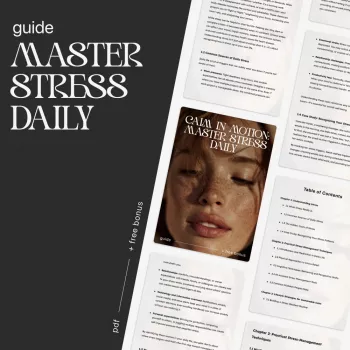
- Calm in Motion: Master Stress Daily (digital download) — mindfulness micro-practices plus AI-assisted reflection to steady focus and reduce stress reactivity.
- Using AI to Practice Empathy Toward Yourself (digital guide) — supportive self-compassion framing when the inner voice gets sharp under pressure.
- A Guide to Resetting Your Mind After Burnout (digital eBook) — a deeper reset for anyone rebuilding routines after an intense season.
Making it stick: barriers and quick fixes
FAQ
How can stress be managed in daily life without adding more tasks?
Use 30–90 second micro-practices during transitions (opening your laptop, walking to the kitchen, starting the car) so regulation happens “inside” your day. The focus is shortening recovery time after stress, not eliminating stress completely.
What makes an AI-guided stress relief routine different from regular journaling?
It’s faster and more structured: brief check-ins, a targeted reframe, and a clear next step instead of long writing sessions. AI can support reflection and habit-building, but it’s not a substitute for therapy or crisis care.
How quickly can mindfulness techniques improve focus?
Some effects can be immediate—slower breathing and grounding can reduce physiological stress and make distractions less “sticky.” Steadier focus tends to build over weeks as consistent repetition trains quicker returns to baseline.









Leave a comment